
Time In

“It takes a lot of time to be a genius. You have to sit around so much, doing nothing, really doing nothing.” — Gertrude Stein
It is good to do nothing.
We often call this a time out, a break, an interruption from the regular routine of life. Because we’re sad, or mad, or tired, and we need it.
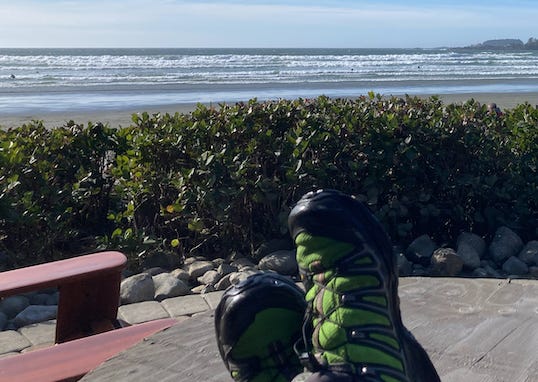
There’s no agenda when it’s a “do nothing” day.
But perhaps, instead of thinking about a “time out” we should reconfigure this period of necessity into a “time in.” Make this an opportunity to take time and space to look and examine inwardly without prejudice and in the complete absence of desire or fear. A “time in” is a non-contained block of life that is devoid of transactional interference, free from culture or commerce. All too often, time outs act as mere escapes, temporary reliefs from either the mundane or the chaotic, whatever be your regular state of affairs. They usually consist of parties and thrills, or the more passive alternatives like the beach vacation or a day at the spa. It may offer some temporary reprieve from the norm but still operates to serve what came before: to make our regular lives more acceptable or worth it. Its reasoning still lies within the marketplace.
“Try to live in a way where you’re not seeking gain or avoiding loss.” — Alan Watts
But with a “time in,” rather than escaping, we dive deeper. We venture through the gates of fear that prevent us from doing so and into that vulnerable abyss which takes on an entirely different delivery, one that alters your regular perspective. We don’t really do this in our day to day act of survival and societal obedience. We ignore the foggy and often obscured grey areas where nuance, complexity and wonder lie. See, life doesn’t happen at posts or milestones but between them. Births, holidays, graduations, weddings, even retirement and death are only events. These seemingly louder, yet often overvalued moments may seem important but in actual life the things that make you who you are really happens in the long string of activities that stretch between them. It is in the middle, where life is made and felt deeply, and we don’t see the truth of this unless we stop the routine of externally-biased living.
"Music is the space between the notes." — Claude Debussey
In film and animation, like in music, the spaces between the notes make them sing. We think the story points are everything but what makes it great, what makes it genuinely timeless and memorable, is the material in the middle. Think of the multitude of little scenes that make a feature length movie amazing or the wonderful breakdown keys in a sequence of animation that give it the specificity in timing, weight and flavour that delights the eyes. The good stuff is in the middle — where the doing is fun — and we often forget this.
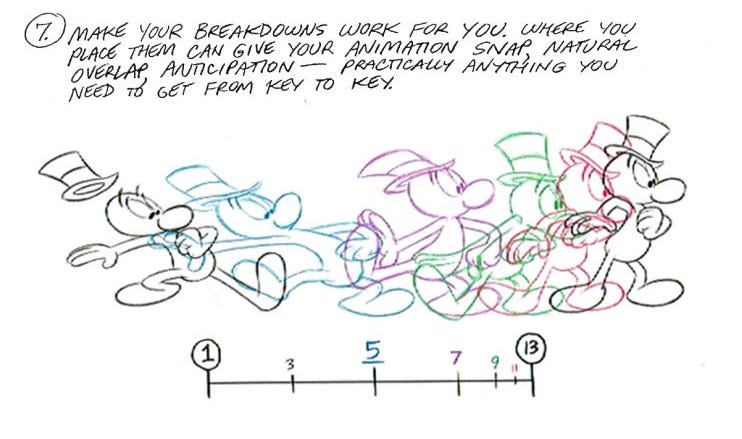
The importance of breakdowns. From Eric Goldberg’s mandatory book on animation, Character Animation Crash Course.
I get it, results satisfy. We all love seeing the dream manifest into physical reality (or at least some facsimile of it). It’s nice to see the ripe tomato at the end of the vine. But we forgot that nurturing and watching the whole plant grow from seed to maturity — which is the majority of its timed existence — is the most beautiful and most meaningful part of gardening. Results are only small events and, events can be faked, made to feel real through repetition and spectacle. Don’t be fooled.
“In societies where modern conditions of production prevail, all of life presents itself as an immense accumulation of spectacles. Everything that was directly lived has moved away into a representation.”― Guy Debord
But here we are, presiding in late stage capitalism, perhaps near the end or transition of empire, and we humans are done with spectacle. We are done with the over-glorification of the end game. We are done with urgency. We are done with everything being digital non-matter. And we are tired of both striving and starving for goals, milestones and other measurements of success. Because they lack meaning. In the long timeline of activity where nothing truly significant happens externally, the best things must happen internally. Here, in this liminal space, we light the lamp.
“An eye or an ear without light cannot know it.” — Rumi
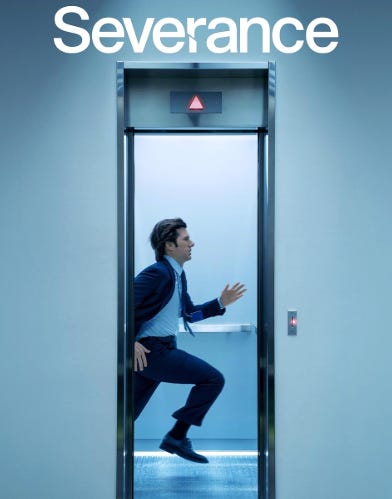
Severance is a show that explores the separation of the mind, literally, of work and afterwork life. But perhaps maybe both states of existence are a lie and the truth lies elsewhere?
So, where do we start? It could be just taking the day off, to sit and bathe in the sun by yourself or to just hangout with a favourite book, one that once moved you, one that changed your view of the world and your life. Or, you could visit that special place or person that, for no particular reason, always brings a smile to your face. Or, it could be just going to the park or into the woods without any goals or time limits in mind. And that is the entire point; to be free of agendas. And don’t bring the phone — forget about so-called “reality” for while — because that digital machine will keep you tethered to the other world. But in that mysterious space called the brain, where the grey matter resides, lies a work of marvelous fiction that is unique to the beauty of one’s own particular journey. This is where we can re-write our external lives. It’ll be the most personal yet paradoxically unselfish thing you’ll ever do.